Field guide · The path
From idea to launch: the 90-day path
A week-by-week structure from raw idea to first paying customer in 90 days: validate, run the numbers, handle the legal basics honestly, build the smallest sellable version, and sell.
Ninety days is not a magic number. It is a forcing function: long enough to genuinely test, build, and sell a small business, short enough that you cannot hide in preparation. This guide lays the arc out week by week, with the honest version of each stage, including the parts most launch content skips.
One caveat before the calendar: no schedule guarantees a customer by day 90. What the structure guarantees is that by day 90 you will know, with evidence, whether this business deserves the next 90. That knowledge is the actual product of the first quarter.
Weeks 1-2: validate before anything else
The first two weeks are pure validation, covered in depth by the first guide in this series: name the idea's weakest assumption, design the smallest test of it, and run the test on real people with a threshold you wrote down in advance. No logo, no LLC, no website. Nothing you would have to throw away if the answer is no.
This ordering is the whole trick of the 90 days. Every week of building you do before validating is a loan taken out against an answer you do not have yet.
Weeks 3-4: run the numbers and make the call
With test results in hand, build the small financial model from the numbers guide: gross margin per sale, monthly fixed costs, break-even, and what it costs to start. Then hold a go or no-go meeting with yourself and treat it as a real decision, not a formality on the way to yes.
Go means the evidence and the math both clear your bar. No-go means park the idea with its notes, which is a success of the process, not a failure of yours: you just bought certainty for two weeks of testing instead of a year of building. The walking-away guide covers how to do it well.
Weeks 5-6: the legal basics, honestly
Here is the plain version of a step that gets oversold. For most one-person businesses you can start as a sole proprietor, the default legal status that exists the moment you start selling, and formalize as you grow. An LLC (limited liability company) is worth understanding, but understand what it actually does: a single-member LLC changes nothing about your taxes, and it does not shield you from claims about your own work, the thing a solo founder is most exposed to. Business insurance is the primary protection; the entity is second. Form the LLC when contracts, partners, or a bank require it, or when you want the separation, not because a checklist said so.
Two things you should do: open a separate bank account so business money never mixes with personal, and if you need an EIN (employer identification number, the tax ID for a business), get it directly from the IRS, where it is free and takes minutes. Third-party sites charge up to $300 for this free form, and some are scams collecting your Social Security number. Check your city and state for licenses your specific trade needs. And none of this is legal advice; rules vary by state and by trade.
Weeks 5-8: build the smallest sellable version
Alongside the paperwork, build, but define building narrowly: the smallest version of the offer a customer can pay for and receive. For a service, that is a one-page description, a price, and a way to book and pay. For a product, a small first batch. For anything digital, the version where you do the automated parts by hand behind the scenes.
Give the brand exactly the afternoon the naming guide prescribes: name checked, one logo, one palette, done. The trap of weeks 5 through 8 is perfectionism wearing the costume of diligence. Your first version should slightly embarrass you; polish is a tax you pay after evidence, not before.
Weeks 9-12: sell, one channel, every week
The last month is selling, done the way the first-customer guide describes: direct offers to warm people and problem-rooms, full price, delivered by hand, every conversation recorded. Pick the one channel your validation pointed to and go deep on it; four weeks split across four channels teaches you nothing about any of them.
Hold a weekly review, thirty minutes, same day each week: what moved, what stalled, what one thing next week has the best claim on your hours. The businesses that reach a first sale are rarely the best-planned ones. They are the ones where somebody kept the loop running.
What this looks like in Alxoria
The 90-day roadmap section of a real Alxoria dossier: the plan above, generated for a specific idea, with week-by-week tasks you can check off.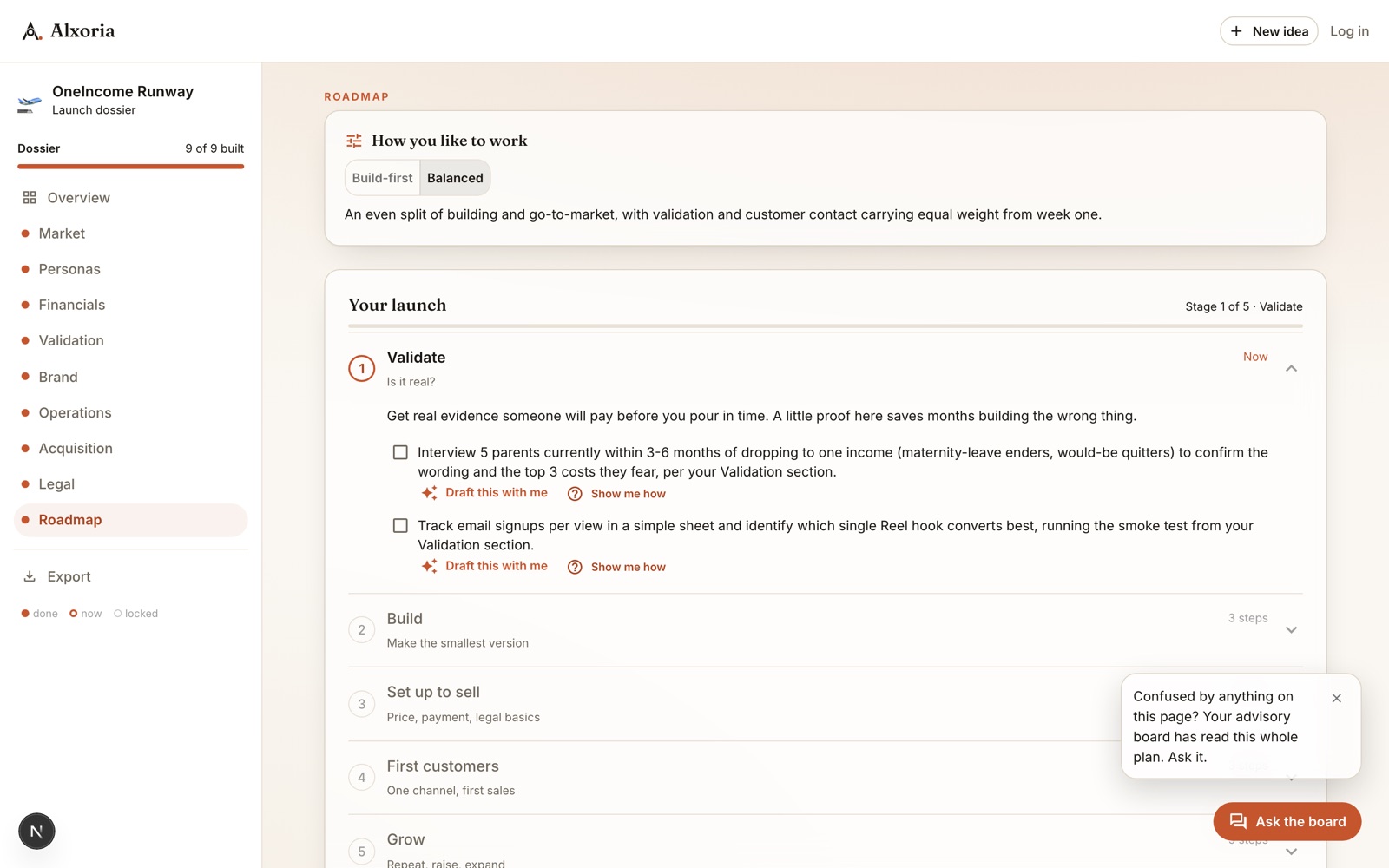
Day 91
By day 91 you are in one of three places, and all three are wins over where you started. You have a paying customer, and the next quarter is about finding the pattern behind them. You have real evidence but no sale yet, and the next quarter is adjusting audience or offer with everything your notes taught you. Or you have a clear no, your savings intact, and a documented idea file for the next attempt. The only losing outcome was the one this structure exists to prevent: ninety days spent polishing, with nothing learned and no one asked to pay.
Alxoria builds this entire path for your specific idea: validation plan, financial model, brand kit, and the week-by-week roadmap, free to start.
Generate your 90-day plan